
Chiropractic was founded by Daniel David Palmer in 1895 when he discovered improvements after performing an adjustment on a janitor who had partially lost his hearing. His patient and friend Reverend Samuel Weed created the word, originally from the Latin “chiro” which means “hand”.
The method by which the chiropractor uses imparts a specific force commonly referred to as an adjustment (verb: adjust), traditionally by hand with a high velocity and specific line of drive (or direction) that results in the restoration of movement and correction of vertebral malalignment. The chiropractor then always corrects functioning to return to the structures from which the nerves in the area flow to. As techniques have developed this impulse may now be done with modalities; additionally chiropractors also can adjust extremities (arms and legs etc).
Chiropractic is best thought of as a 3 legged stool based around philosophy, science and art. Each represents a leg, all of which are fundamental to understanding the profession. The philosophy is “why to adjust”, the science is “how to adjust” and the art is “where to adjust”.
Today however, while the principle is still simple, the science has become more developed. We know that whilst chiropractic provides significant benefits to a number of conditions its philosophy is not based in treatment of any one condition or even many, but simply the removal of interference allowing the self-healing and self-regulating power that made the body to heal the body. This inner wisdom is referred to by chiropractors as innate intelligence (inner intelligence) born into any living thing. Chiropractic is a drugless profession. The nerve interference was first called a subluxation (joint out of normal position) but others have discarded the word and prefer simply facet/joint restriction.
 No. Chiropractic should never hurt. On the first session we will go easy with you. We understand that it is a new environment and will explain everything we are doing every step of the way. However, you can sometimes ache slightly after an adjustment. We liken this feeling to the first game of a season. If you start using muscles that you have not used for a while you may feel a little ache at worst.
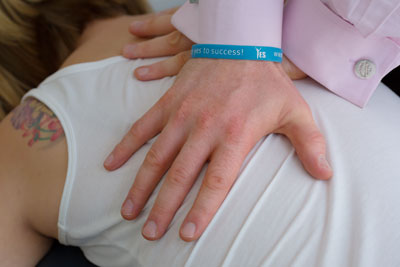 Some people hear a gentle popping sound when they get adjusted; it is not painful.